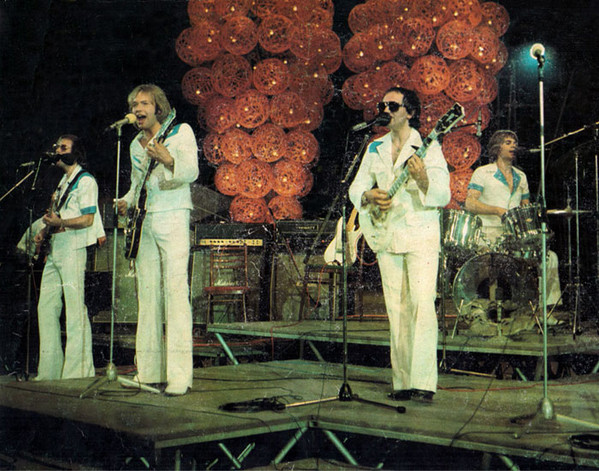
In 1973, Wayne Bickerton, then head of A&R at Polydor Records, wrote four songs in an "American 50's type" sound with co-writer Tony Waddington. A group of session musicians and singers were gathered in a London studio and recorded a demo of these tracks. Three of the session musicians were then asked to form the beginnings of a band, and with that John Richardson, Alan Williams and Pete Arnesen were the start of The Rubettes. John got some musician friends to round out the group, with Mick Clarke, Bill Hurd and Tony Thorpe making the original group of six.
Pete Arnesen, the only American of the group, was the first to part ways. Later, Bill Hurd chose to pursue a solo career, cutting the band to four. Tony Thorp left the band in 1979, and the final three continued to make music together.
In 1982, the band re-formed to tour on the wave of nostalgia. This time, Alan Williams and Mick Clarke were joined by Bill Hurd and Alex Bines, once Hurd's Milkman, completed the revised line up on drums. Mick Clarke was replaced by Steve Kinch 1987-1991 and Trevor Holliday 1991-1993. c.1992: the line up was Alex Bines, Alan Williams, Trevor Holliday and Bill Hurd.
In 1999, the re-formed line up split again, forming two "competing" Rubettes groups, one lead by Bill Hurd and the other by Alan Williams. This resulted in two separate entities, who took distinct names following a court order, making The Rubettes featuring Bill Hurd and The Rubettes feat. Alan Williams. William's group consists of Alan Williams, John Richardson, Mick Clarke, and Mark Haley.
Sidenotes:
Of the Original Rubettes line-up only John Richardson, Alan Williams and Pete Arnesen participated in the recording of "Sugar Baby Love" with the falsetto lead vocal performed by Paul Da Vinci (legal name: Paul Prewer). With contractual obligations preventing Prewer from joining the band when it was formed, he never toured with the original band. He later featured with Hurd, Bines and the rest in this Rubettes formation from 2000 until 2006, when he left for personal reasons and is replaced by George Bird.
The band name was born from the interest in jewel-based names like "Diamonds," and one of Thorpe's girlfriends owned a purplish-red colored Mini which she affectionately called "Ruby."
If you like The Rubettes, check out these artists:

1998

1994

1993

1993

1992

1990

1989

1989

1989

1987
The Rubettes
The Rubettes
The Rubettes
The Rubettes
The Rubettes
The Rubettes
The Rubettes
The Rubettes
The Rubettes
The Rubettes
The Rubettes
The Rubettes
The Rubettes
The Rubettes
The Rubettes
The Rubettes
The Rubettes
The Rubettes
The Rubettes
The Rubettes
August 1, 2025
Marktplatz
Leipzig, Saxony, Germany1. Saturday Night
2. Tonight
3. I Want You to Want Me(Cheap Trick cover)
4. Foe Dee Oh Dee
5. Glory Days(Bruce Springsteen cover)
6. Never Be Alone
7. All the Young Dudes(David Bowie cover)
8. Get It On(T. Rex cover)
9. Rebel Rebel(David Bowie cover)
10. Little Darling
11. You're the Reason Why
12. Baby I Know
13. Some Guys
14. Darlin'(Frankie Miller cover)
15. Radar Love(Golden Earring cover)
16. 21st Century Rock 'n' Roll
17. You Ain't Seen Nothing Yet(Bachman–Turner Overdrive cover)
18. Juke Box Jive
19. I Can Do It
20. Sugar Baby Love
1. California Man
December 6, 2024
Silt
Middelkerke, West Flanders, BelgiumSeptember 19, 2023
Arena di Verona
Verona, Veneto, Italy1. Sugar Baby Love
September 10, 2022
Theater Markant
Uden, North Brabant, Netherlands1. Tonight
2. Listen to the Music(The Doobie Brothers cover)
3. Heartache Tonight(Eagles cover)
4. Baby I Know
5. Mr. Tambourine Man(Bob Dylan cover)
6. Bye Bye Love(Boudleaux Bryant cover)
7. Crying in the Rain(Carole King cover)
8. All I Have to Do Is Dream(Boudleaux Bryant cover)
9. Tomorrow
10. Juke Box Jive
1. Foe-Dee-O-Dee
2. You Ain't Seen Nothing Yet(Bachman–Turner Overdrive cover)
3. Tulpen uit Amsterdam(Herman Emmink cover)
Shortened, with public sing along4. Saturday Night
5. Have You Ever Seen the Rain?(Creedence Clearwater Revival cover)
6. A Whiter Shade of Pale(Procol Harum cover)
7. I Can Do It
8. Together We Stand
9. Sugar Baby Love
1. Proud Mary(Creedence Clearwater Revival cover)
August 27, 2022
Soetebeekstraat
Bree, Limburg, BelgiumAugust 8, 2022
Marktplatz
Leipzig, Saxony, Germany1. Listen to Music
2. Tonight
3. You Ain't Seen Nothing Yet(Bachman–Turner Overdrive cover)
4. Foe-Dee-O-Dee
5. Heartache Tonight(Eagles cover)
6. Baby I Know
7. Saturday Night
8. Have You Ever Seen the Rain?(Creedence Clearwater Revival cover)
9. A Whiter Shade of Pale(Procol Harum cover)
10. Juke Box Jive
11. Tomorrow
12. I Can Do It
13. The Lion Sleeps Tonight(Solomon Linda’s Original Evening Birds cover)
14. Bye Bye Love(Boudleaux Bryant cover)
15. Crying in the Rain(Carole King cover)
16. All I Have to Do Is Dream(Boudleaux Bryant cover)
17. Together We Stand
18. Sugar Baby Love
1. Proud Mary(Creedence Clearwater Revival cover)
1. Johnny B. Goode(Chuck Berry cover)
CHUCK BERRY coverAugust 26, 2018
Bobbejaanland
Lichtaart, Antwerp, BelgiumJuly 21, 2018
Kursaal
Ostend, West Flanders, BelgiumJune 16, 2018
Hutbergbühne
Kamenz, Saxony, GermanyJune 15, 2018
Freilichtbühne
Spremberg, Brandenburg, GermanyMay 20, 2018
Parc de la Glissoire
Avion, Hauts-de-France, FranceNovember 16, 2017
Astor Theatre
Perth, Western Australia, AustraliaNovember 10, 2017
Shoppingtown Hotel
Melbourne, Victoria, AustraliaAugust 27, 2017
Bobbejaanland
Lichtaart, Antwerp, BelgiumAugust 11, 2017
Grote Zavel / Grand Sablon
Brussels, Brussels-Capital Region, BelgiumAugust 5, 2017
Beckingham Bell
Maldon, England, United KingdomJune 10, 2017
Waldbühne
Schwarzenberg, Saxony, GermanyAugust 21, 2016
Festivalterrein Kluitshofweg
Bree, Limburg, Belgium1. Foe-Dee-O-Dee
2. Juke Box Jive
3. Ooh la La
4. Little Darling
5. Baby I Know
6. You're the Reason Why
7. Taiko Drums
8. Happy Birthday to You(Mildred J. Hill & Patty Hill cover)
9. Tonight
10. Julia
11. Sweet Soul Medley
12. I Can Do It
13. Sugar Baby Love
July 23, 2016
Aquapulco
Bad Schallerbach, Upper Austria, AustriaDecember 8, 2015
Fairfield Halls
Croydon, England, United Kingdom1. Juke Box Jive
2. Sugar Baby Love
3. I Can Do It
The Rubettes has released 33+ albums. Some of their notable releases include The Very Best Of The Rubettes, Smile, Best Of The Rubettes. Explore their complete discography on this page.
Some of The Rubettes's most popular tracks include Sugar Baby Love, Juke Box Jive, I can Do It, Tonight, You're The Reason Why. Listen to these songs and discover more from their extensive catalog.
In 1973, Wayne Bickerton, then head of A&R at Polydor Records, wrote four songs in an "American 50's type" sound with co-writer Tony Waddington. A group of session musicians and singers were gathered... Read the full biography on this page.
You can find The Rubettes vinyl records and merchandise on eBay. We feature a curated selection of vinyl releases and collectibles available for purchase.
View All Similar Artists
Follow The Rubettes
